
Resilienssi ja verkkohäirintä forumin aiheina
(In English below)
Miten suojata rakenteet ja verkot, joihin digitaalinen arki nojaa, miten saada verkkohäirintä kuriin? Finnish Internet Forum 2025 joutui – viime vuosien tapaan –keskittymään uhkien torjuntaan enemmän kuin mahdollisuuksien hyödyntämiseen. Kolmas teema oli YK:n tietoyhteiskuntakokouksen 2-vuotisseuranta. Tilaisuus järjestettiin 8.10 Pikkuparlamentissa Helsingissä.
Finnish Internet Forum on alusta (2010) lähtien järjestetty yhteistyössä eduskunnan tulevaisuusvaliokunnan kanssa. Avauspuheenvuorossaan valiokunnan varapuheenjohtaja Timo Harakka korosti laaja-alaisen TuV:n eroa monien muiden maiden parlamenteissa reaktiivisesti perustettuihin digitalisaatio- tai tekoälyvaliokuntiin. Ne eivät hänestä liian kapea-alaisina vastaa parlamentarismin perusajatusta että yhteiskuntien ja ihmiskunnan tulevaisuus ratkaistaan ihmisten tekemillä valinnoilla ja päätöksillä. Teknolgia luo kasvua mutta ihminen tekee valinnat, ”Ja tämä tuo minut takaisin tähän 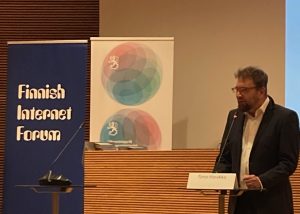 Internet-forumiin, koska ajattelen että meidän perimmäinen päämäärämme on löytää ne keinot joilla ihmiset yhteistyössä hallitsevat ja kehittävät internetiä yhteiskuntien ja ihmiskunnan parhaaksi. Ja me elämme rajallisten resurssien maapallolla. Onko niin että planeetta on valjastettu tekoälyn tarpeisiin, vai löydämmekö me sellaisen tien niin että tekoäly palvelee planeettaa?”
Toisen avauspuheenvuoron piti Antti Vasara, joka toimii ulkoministeriössä Suomen kansainvälisen teknologiapolitiikan erityisedustajana. Hänen puheenvuoronsa liitti fooumin teemat internetin teknisen ja turvallisuusympäristön kehitykseen, jonka myötä esimerkiksi maantieteelliset etäisyydet ovat menettäneet merkityksensä, hyvässä ja pahassa. Rikokset tehtiin ennen paikallisesti, nyt globaalisti. Huolenpito infrastruktuurin turvallisuudesta on edellytys luottamukselle, jota ilman teknisen kehityksen tarjoamat edut jäävät saavuttamatta, ja laajaa keinovalikoimaa on käytettävä jotta kaikki tuntevat olonsa turvalliseksi verkossa.
Vasara varoitti digitaalisen autoritaarisuuden vaaroista Internetille ja demokratialle, ja vaati vahvistamaan tietoisuutta sensuurin ja valvontajärjestelmien leviämisestä ja teknologian käytöstä sosiaalisen kontrollin välineenä
”Suomi on tunnettu vahvasta digiosaamisesta ja avoimesta yhteiskunnasta. Meillä on mahdollisuus näyttää suuntaa, ei vain teknologian kehityksessa, vaan myös sinä, miten teknologiaa säädellään, seurataan ja käytetään eettisesti ja ihmislähtöisesti.”
Keynote-puhujana oli internetin tunnisteiden (IP-osoitteet, domain-nimet etc.) teknisestä koordinaatiosta vastaavan ICANN:n presidentti ja CEO Kurt ”Kurtis” Lindqvist, joka on ensimmäinen suomalainen (ahvenanmaalainen) tuossa tehtävässä (joulukuusta 2024 lähtien). Hän oli aikanaan saarimaakunnan ensimmäinen internet-palveluntarjoaja, ja hänen puheenvuorossaan kulki selvä linja pioneeriajoista nykyhetkeen: internet on kasvanut valtavasti mutta toimii edelleenkin hyvin nimenomaan siksi, että ”ingen äger, styr eller kontrollerar det”. Internet ei perustu valtasuhteisiin vaan yhteistyöhön, hän kiteytti ja selosti ICANN:n omaa, kapeaa mutta tärkeää teknistä roolia tässä yhteistyössä. Sisällön valvonta ei kuulu siihen; toisaalta velvoite toimia järjestelmän väärinkäytöksiä vastaan poistaa ”sisällön” suojan esim. phishing-huijauksilta. Myös Lindqvist varoitti ”joidenkin maiden” yrityksistä keskittää internetin hallintaa tavalla joka itse asiassa johtaisi internetin hajoamiseen (fragmentaatioon), ja puolusti kaikkien toimijoiden osallistumista internetin hallintaan (multistakeholder model), josta ICANN itse on hyvä esimerkki. Hän havainnollisti mallia suomenkielisellä sanonnalla ”kysyvä ei tieltä eksy”: harhaan ei mennä kun eri toimijat puhuvat toisilleen.
Komentaja evp. Olli Peltonen selosti Suomen kansainvälisten yhteyksien riippuvuutta Itämeren merikaapeleista. Niiden reititys on julkista tietoa, ja ne ovat helppoja maaleja pahantahtoisille toimille, jollaisina hän piti viimeaikaisia Suomenlahsden kaapelikatkoja, jotka olivat aiheutuneet kun laivat olivat raahanneet ankkureitaan meren pohjalla. ”Meitä kokeillaan”, hän varoitti. Siitä huolimatta että yhteyksiä on näennäisesti yli tarpeen, on varauduttava pahimpaan. Tämä tarkoittaa mm. kaapelien korjauskapasiteetin lisäämistä esim. varustamalla jäänmurtajat tätä varten, ja harjoittelemalla yhteyksien uudelleen reitittämistä.
FICOM:n toimitusjohtaja Elina Ussa aloitti toteamalla että jos verkot eivät toimi, yhteiskunta pysähtyy. Ukrainassa yhteyksien ylläpito on selkeä prioriteetti. Kolme ”pointtia”: 1) Kriisitilanteessa yksikään operaattori tai viranomainen ei pärjää yksin, keskinäinen luottamus ja yhteistyö ovat välttämättömät; 2) Sääntelyn selkeys ja ennustettavuus: kriistilanteessa ei ole aikaa juristien väitellä mitä pykälät tarkoittavat; ja 3) Resilienssi ei säätäen synny, se saavutetaan vain harjoittelemalla ja testaamalla. Ukrainassa operaattorien roaming-yhteistyö toimii kirjaimellisesti elämänlankana koska ne olivat harjoitelleet verkkojensa avaamista toisilleen.
Liikenne- ja viestintäministeriön tietoliiketoimintayksikön johtaja Maria Rautavirta totesi että resilienssin ytimenä ei ole eristäytyminen vaan ketterä reititys joustavan kokonaisuuden puitteissa, samalla tavalla kuin internet toimii. Alustat ovat ottaneet haltuunsa aikaisemmin yhteiskunnalle kuuluneita toimintoja, mutta EU pyrkii nyt ottamaan niitä takaisin.
Euroopan komission viestintäverkkojen, sisältöjen ja teknologian pääosaston varapääjohtaja Christiane Kirketerp de Viron sai paneelin viimeisen sanan, etänä Brysselistä. Hän sanoi että Euroopan kriittisen infrastruktuurin resilienssi ei koskaan ole ollut niin tärkeä kuin nyt, kun se on jatkuvien hyökkäyksien kohteena eri tahoilta.Hän korosti yhteistyön tarvetta julkisen ja yksityisen sektorin välillä, ja yleensä kaikkien toimijoiden kesken EU:n toimintalinjauksien (NIST-2, kyberkestävyyssäädös etc.) toimeenpanossa.
Toisen paneelin teemana oli verkkohäirintä ja toimenpiteet kohti turvallisempaa verkkoa, moderaattorina Generation Equality-ryhmän puheenjohtaja Oona Kurppa. Aiheen esitteli ”Sua varten somessa”- palvelun johtava asiantuntija Reetta Hänninen. Hän esitteli hätkähdyttäviä tutkimustuloksia nuorten kokemuksista verkossa, jossa 80% oli nähnyt häirintää ja 40% joutunut sen kohteeksi. Verkkohäirinnästä on tullut erottamaton osa koulukiusaamista ja muuta nuorten kokemaa henkistä väkivaltaa. Verkkoviettelyä (grooming) oli 11-17 vuotiaista joutunut kokemaan 31 %. Näistä 60% eivät kerro kenellekään kokemuksistaan; ne jotka kertovat, uskoutuvat useimmin ystävilleen kuin aikuisille, ja vain 10% tapauksista tulee viranomaisten tietoon.
Naisten linjan väkivallan vastaisen työn asiantuntija Ella Granström kertoi että verkkohäirintä kuuluu palvelun apua hakevien naisten kokemuksiin. Se lisää heidän pelkojaan ja ahdistaan ja saa heidät tuntemaan toivottoman yksinäisiksi. Avain heidän auttamiseensa on ottaa heidät vakavasti, vähättelemättä heidän kokemiaan traumoja.
Elisan vastuullisuusjohtaja Minna Kröger totesi operaattorin suhtautuvan ongelmaan proaktiivisesti ja kouluttavan lapsia 7-vuotiaasta alkaen SuperDigikouluohjelmassa, jonka etäoppitunneille lokakuussa 2025 oli ilmoittautunut yli 430 koulua ja yli 95 000 yläkoululaista ympäri Suomea.
Vihreiden kansanedustaja Atte Harjanne katsoi että vaikka internetin kehitys on alentanut verkkoväkivallan kynnystä, keinoja joilla oikeusvaltio tähän voisi puuttua ei ole vastaavasti skaalattu. Hän vaati alustoja ottamaan ongelman vakavasti, ja muiden puhujien tavoin asetti tavoitteeksi luoda kulttuuri ja keinot, joilla varmistetaan että nuoret eivät jää yksin pahojen kokemuksiensa kanssa.
Minna Kröger yhtyi viimeksimainittuun ja kommentoi että Elisan tutkimuksen mukaan vain 4% verkkohäirintää kokeneista lapsista on pystynyt keskustelemaan siitä turvallisen aikuisen kanssa.
Moderaattorin kysymykseen,ovatko kansanedustajat tietoisia ongelmasta ja halukkaita tekemään sille jotakin, Harjanne vastasi että koska jokainen internetin käyttäjä kohtaa erilaisen sisällön kuin muut, lasten käyttäjäkokemus saattaa olla vaikea ymmärtää. Siksi ongelmista on tärkeätä kuulla niiltä, joita ne koskevat, lapsilta ja nuorilta, eikä sanella ratkaisuja heidän päidensä ylitse.
Kaikki panelistit olivat samaa mieltä siitä että vaikka verkkohäirintä useimmin kohdistuu tiettyihin ryhmiin – naiset, lapset ja nuoret, erilaiset näkyvät ja haavoittuvat ryhmät – se voi myös olla uhka koko yhteiskunnalle ja demokratialle, koska sen on harjoittajilleen helppoa ja tekninen kehitys, kuten tekoäly, pahentaa sitä.
Ehdotus yleisöstä: kuten kaupunkiliikenteessä, alustojen tulisi toteuttaa verkossa ”suojateitä”, turvallisia, häirinnästä vapaita alueita.
Päivän viimeisenä aiheena oli WSIS+20 eli YK:n tietoyhteiskuntahuippukokouksen tulosten 20-vuotisseuranta, erityisesti Internet Governance Forumin tulevaisuus, joka ratkeaa YK:n yleiskokouksessa vuoden lopulla. Moderaattorina oli Suomen Inernet-yhdistyksen hallutuksen jäsen, lähetystöneuvos Mervi Kultamaa. Kansanedustaja Miapetra Kumpula-Natri, joka MEP-aikanaan osallistui usein IGF:n parlamentaarikkokokouksiin kertoi kokemuksistaan ja kiinnitti huomiota myös IGF:n suuren osanottajamäärän ja runsaan aihetarjonnan aiheuttamiin ongelmiin. Lähetystöneuvos Janne Hirvonen totesi että IGF on ikään kuin jäävuoren huippu sen ympärille syntyneessä alueellisten ja kansallisten foorumien ekosysteemissä.
Viimeisenä esiintyi esitti Traficomin teknologia- ja strategiajohtaja Kirsi Karlamaa, joka veti yhteen keskustelujen tärkeimmät tulokset, korostaen käsiteltyjen teemojen läsnöoloa arjessa: ”Jos kaapeli katkeaa, yhteydet eivät toimi .Jos häirintä hiljentää keskustelun, demokratia heikkenee. Jos hallintomalli murtuu, menetämme yhteiset säännöt. Siksi meidän on vahvistettava sekä kovaa että pehmää infrastruktuuria”.
Finnish Intenet Forum 2025 discusses resilience and harassment
How to protect the infrastructure that our digital everyday life is based on, how to tackle digital harassment on the net? Finnish Internet Forum 2025 had to focus more on threats rather than opportunities. However, that was somewhat balanced by the third theme of the conference, WSIS+20 and its efforts to preserve for the future the best of two decades of the follow-up of the World Summit on Information Society.
Finnish Internet Forum, the Finnish national IGF, has since 2010 been organized by a wide array of stakeholders, among which the Ministry for Foreign Affairs and the Finnish Internet Association (ISOC Finland Chapter) have been the most consistently engaged, in partnership with the Committee of the Future of the Parliament, which again made it possible for the forum to meet in the auditorium of the Annex of the Parliament (“Little Parliament”)
The 2025 forum was opened by the Vice-Chair of the committee, Timo Harakka (MP-Social Democrats), who highlighted its role in enabling people to make the choices and decisions about technologies of the future, rather than just reacting to the development of single strands of technology. “Has the planet been harnessed to the needs of AI, or can we make the AI to serve the planet?”
In his opening remarks, Antti Vasara, the MFA special envoy on international technology policy, warned about the dangers of digital authoritarianism, and called for sharper awareness of the spread of surveillance systems, censorship, and the use of technology for social control. “Finland is known for its strong digital competence and open society. We have an opportunity to lead the way not only in the development of technology, but also in its regulation in an ethical and people-centered way”, he said.
In his keynote speech, Kurt “Kurtis” Lindqvist, President and CEO of ICANN since December 2024, returned to the times when he set up the first internet service provider (ISP) on the Åland islands, an autonomous province of Finland. In his speech, there was a clear line from those pioneering times to the present, when the Internet, despite its enormous expansion, still works well because “nobody owns, directs or controls” it. Internet is not about power, it is about cooperation, he said and warned about the efforts by “some countries” to centralize its governance in a way that may lead to fragmentation.
Resilience of digital infrastructure, a hot topic in Finland after various incidents in recent months, was the theme of first panel. It was introduced by the moderator Julf Helsingius, Chair of the Board of Base N and member of the Board of ISOC Finland. He noted that to a certain extent, internet has resilience built in, but it has its limits, and they are being tested today.
Kurtis Lindqvist agreed that malicious attacks against the physical infrastructure are getting attention now, but policy decisions that fragment the internet may be equally dangerous. “We can have an internet the most resilient physical infrastructure, but if it then starts fragmenting, the harm can be worse than that from cutting sea cables, and it is easier to do,” he said and stressed the need to ensure the resilience of all layers of the internet.
Olli Peltonen, expert in ICT preparedness and cyber defence, a retired Navy Commander, explained Finland’s dependence on sea cables in the Baltic for its international connectivity. Their location is public knowledge, and they are easy soft targets for malicious action, something that he saw behind recent incidents on the Gulf of Finland when ships had damaged cable by dragging their anchors on the seabed. “We are being tested”, he warned. “In spite of apparent redundancy, we need to prepare for worst case scenario. That means increasing the capacity for cable repairs, eg. by adding such capabilities to the Finnish icebreaker fleet, and rehearsing rerouting of communications.”
Elina Ussa, the CEO of FICOM, started with simple fact: If networks fail, society ceases to exist. The priorities in Ukraine have been clear: keeping the country connected, no matter what. She encapsulated her recommendations in three points: 1) In a crisis, no operator or public authority can make it alone, mutual trust and cooperation are a must, 2) Clear and predictable regulation; in a crisis, there is not time for lawyers to debate, what a paragraph means; 3) Training and practice: resilience can´t be legislated, it must be trained and tested. In Ukraine, national roaming became the lifeline, because operators had trained opening their networks to each other.
Maria Rautavirta, Head of Data Policy at the Ministry of Transport and Communications
agreed that the core of resiliency is not isolation, but switchability within s flexible structure, comparable to that of the internet itself. She noted that platforms had captured a large part of tasks that belonged to society, but now the European Union was working to get them back.
‘
Christiane Kirketerp de Viron, Deputy Director-General ,(Digital Society, Trust and Cybersecurity), of DG CONNECT, European Commission, participating remotely from Brussels, had the last word on this panel. She stated that resilience of European critical infrastructures has never been more relevant than now, when it is under continuing attacks in various ways. She also stressed the need of cooperation between public and private sector, and among all stakeholders, in implementing the robust policy structures now in place to defend the European critical infrastructures (NIST-2, Cyber resilience act etc.)
The second panel was about tackling cyber harassment and making the Internet safer, moderated by Oona Kurppa, Chair of Generation Equality and introduced by Reetta Hänninen, Leading expert at Sua varten somessa, an award-winning non-profit that operates on social media platforms to support youth aged eight to 21 years. She presented shocking survey results: 80% of young people had seen harassment on the internet, 40% had been its target. Digital harassment has become part and parcel of school bullying and other forms of abuse experienced by young people. Of 11–17 year olds, 31% have received grooming attempts by adults. Of those targeted, 60 % don’t tell anybody about their experiences, and those who do, tell their friends and not adults. Authorities become aware of only 10 %.
Ella Granström, anti-violence expert from Naisten linja (Women’s Line), a non-profit servce, stated that digital harassment is also part of the experience of the women that seek help from her organization. It exacerbates their fears and anxieties and leaves them feeling hopelessly alone. For anybody trying to meet and help them, the key is to believe them and not to downplay the trauma they have experienced.
Minna Kröger, Corporate Responsibility Director of Elisa described the operator´s proactive approach to the problem by promoting the digital skills of Finnish children through its digital schools. Starting from the age of 7, children get to practice the basics of digital security and discuss their own safety online.
Atte Harjanne (MP – Green Party) noted that while the development of the Internet has lowered the threshold for digital harassment, the means at the disposal of the state to cope with the situation have not been scaled up accordingly. He urged platforms to take the problems seriously, and called for a culture that does not leave young people alone with their bad experiences.
Minna Kröger agreed with Harjanne on the last point and said that according to Elisa´s surveys, only 4 % of the children who experience digital harassment feel that they can discuss it with an safe adult.
To the moderator´s question about the awareness of the problem and willingness to do something about it among MP’s, Harjanne replied that since the Internet presents a different face to each user, it may be difficult to MP’s to understand the use experience of children. That´s why it is useful to hear about the problems directly from children and young people, and not to try to dictate solutions over their heads.
All panelists agreed that even tough children and young people, girls and women, and various vulnerable and visible groups are most prone to digital harassment, it can also be a threat to the democratic society as a whole, because it is so easy, and because technical development – like AI – is making it worse.
A suggestion from the floor: as an analogy from urban traffic, “pedestrian crossings” should be provided by platforms as safe, harassment-free areas.
The last item of the day was WSIS+20, especially the future role of the Internet Governance Forum, which is going to be decided by the UN General Assenble by the end of the year. It was moderated by Mervi Kultamaa, counselor at MFA and member of the Board of ISOC Finland chapter..
Miapetra Kumpula-Natri (MP – Social Democrats), who earlier as a Member of the European Parliament participated in the parliamentary track sessions of many IGF’s, related her experiences and came with critical remarks and suggestions for how to improve the conference whose sheer size and huge selection of different topics make it problematic. Janne Hirvonen from MFA noted that the IGF is only the apex of a large system that has grown to include some 170 regional and national for a, including the Finnish one.
Closing remarks, with a succinct summary of the important points of the day´s proceedings, were presented by Kirsi Karlamaa, technology and strategy director of Traficom. She concluded pointing out the hidden presence of Internet governance in everyday life: “When a cable is cut, you can´t get a connection. When harassment muzzles discussion, democracy is weakened. When governance is broken, we lose shared rules. That´s why we have to strengthen both the hard and soft infrastructure.”
Tallenne 8.10. pidetystä Finnish Internet Forumista on katsottavissa tästä